Search “omni imaging” or “OmniPACS” today, and the results point to a company that just finished the biggest change in its history. In July 2026, OmniPACS moved every customer onto a fully rebuilt platform: OmniPACS Condor. If you have not heard the name Condor before, that is by design. It is not a new feature bolted onto the old software.
It is what OmniPACS is now, built from the ground up on a modern foundation instead of the decade-old PHP application that carried the company for years. Rebuilding a production PACS system while it is actively running clinics is not a decision anyone makes lightly. New code has to match years of accumulated behavior exactly, on systems where a missed edge case can mean a delayed report or a study nobody can find.
So the honest question deserves a straight answer: why take on a PACS platform rebuild of this size, when the old system was still working?
What Technical Debt Actually Costs a Clinic
The answer starts with technical debt: the accumulated cost of every quick fix, patch, and workaround a piece of software picks up over years of active use. A system that never gets rebuilt does not stay still. It slows down as more logic stacks on top of an aging core.
Integrations that once took days to build start taking weeks, because every new connection has to route around code nobody wants to touch. Features that should be straightforward to ship instead sit in a backlog, because building them safely on the old foundation takes longer than building them from scratch would.
This pattern has a name in software engineering research. A 2024 study on organizational debt describes it as the buildup of outdated structures, policies, and processes that quietly narrows how much an organization can adapt or innovate, the same way unpaid technical debt narrows what a codebase can still do.
Where This Shows Up for a PACS Vendor
For a PACS vendor, that narrowing shows up in three specific ways: pages that take a beat too long to load during a busy shift, integrations that break in ways nobody can fully explain anymore, and a roadmap that keeps slipping because every new idea has to survive contact with fifteen-year-old code first.
None of that is a knock on the people who built and maintained that code. It is what happens to any software system given enough time and enough demands placed on it.
Alpha Earned Its Retirement
That original system had a name internally: Alpha. It was OmniPACS’s first PHP application, and it did its job well. Alpha served real clinics, real radiologists, and real patients for years, through a stretch when PACS software went from a nice-to-have to core clinical infrastructure. Retiring it is not a story about a bad product.
It is a story about a product that did exactly what it was built to do, for long enough that the world around it changed more than the code underneath it could keep pace with. Every clinic running OmniPACS today is running on Condor because Alpha proved the underlying business case first. That is worth saying plainly: a rebuild announcement can easily read like an implicit insult to what came before it, and this one is not meant that way.
Inside the PACS Platform Rebuild: What Changed Under the Hood
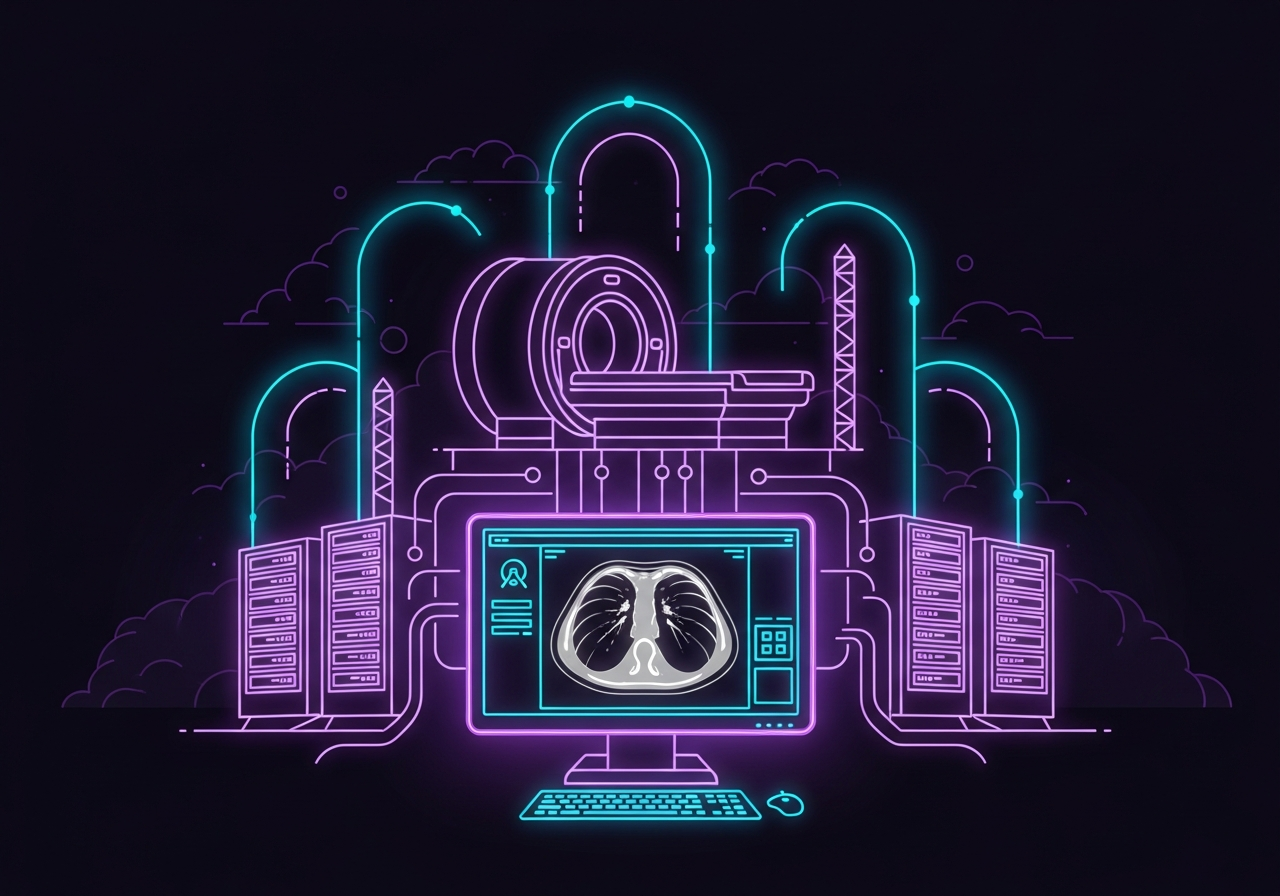
OmniPACS Condor is not a new interface layered on the same backend. It is a full rebuild: a Python and Django backend paired with a React front end, replacing Alpha’s PHP codebase end to end. That distinction matters more than it might sound like it does. A modern, API-first backend means new features can be built as independent, testable services instead of changes threaded carefully through a decade of PHP logic.
A React front end means the interface can update in place, without full-page reloads breaking a radiologist’s train of thought mid-study. The clearest way to see what that looks like in practice is to watch it.
The practical payoff of that architecture shift is speed: specifically, the speed at which new capability can ship. A feature that would have taken a quarter to build safely on Alpha can realistically ship in weeks on Condor. That is not a marketing line. It is what a modern, decoupled architecture is built to do, since services can change independently, get tested on their own, and ship without waiting on the rest of the system to catch up.
The July 2026 Cutover: Every Customer, No Lost History
Rebuilding the software was one project. Moving every existing customer onto it without losing a single study, worklist, or audit record was a different one entirely, and arguably the harder of the two. OmniPACS completed that cutover in July 2026. Every customer account moved from Alpha to Condor, with full history preserved on the new platform.
That cutover got the same discipline we would want any facility to bring to a PACS migration of its own: a full plan, a defined rollback path, and verification at every stage instead of one all-at-once leap of faith. Anyone who has lived through a rough PACS migration before knows exactly what could have gone wrong here. The goal was to make this one boring by comparison, which is exactly what a well-run migration should be.
Easier and More Intuitive, Not Reinvented
It would be tempting to call Condor more powerful or smarter than what it replaced. That is not the honest claim, and honesty is the better differentiator in a category full of overpromising. What actually changed is that the boring, everyday parts of the job (finding a study, sharing it, getting notified when something needs attention) got easier and more intuitive. Nothing about what a tech or a radiologist does on a given day changed.
How long it takes to do it did.
The Foundation for What’s Next
That distinction is also what makes the harder things possible. A cloud PACS platform built on a modern, API-first foundation is not just easier to use today. It is a foundation flexible enough to eventually support work that was genuinely difficult to build on Alpha: enterprise-level user administration, real operational analytics, a native mobile app, and a worklist that helps surface the most urgent studies first. None of that is available yet, and none of it carries a firm date here.
What is true today is that the foundation to build it now exists, where before it did not.
What This Means If You Searched “Omni Imaging”
If you searched “omni imaging” looking for the platform you already use, the practical answer is simple: you are on Condor already, your history moved with you, and the platform you log into every day is the one this article describes. If you are evaluating imaging software for the first time, the more useful takeaway is that the platform underneath a PACS system matters as much as the feature list sitting on top of it. A modern architecture is what makes fast iteration and long-term reliability possible at the same time, instead of one coming at the expense of the other.
Reading about a rebuild only goes so far. See the new Condor experience for yourself, and judge the “easier, not reinvented” claim against your own worklist instead of taking our word for it. Existing customers with questions about anything that changed in the move to Condor can always reach our team directly at support@stage.omnipacs.com.